DPP ROI Calculator: The Business Case for Digital Product Passports Beyond Compliance
You've heard about Digital Product Passports (DPP). You understand the European Union's Ecodesign for Sustainable Products Regulation (ESPR) is coming. Maybe your legal team has flagged compliance requirements, or a competitor mentioned they're implementing transparency initiatives. But here's the question keeping you from pulling the trigger: Is DPP worth the investment beyond just avoiding regulatory penalties?
The answer, backed by market research, consumer behavior data, and early adopter case studies, is a resounding yes. Digital Product Passports represent one of the highest-ROI sustainability investments an e-commerce brand can make—if you understand both the costs of inaction and the revenue drivers of transparency.
This guide breaks down the complete business case for DPP implementation, providing a framework for calculating return on investment that goes far beyond compliance checkboxes. Whether you're presenting to stakeholders, evaluating budget allocation, or simply deciding if now is the right time to act, you'll find the financial clarity you need.
Understanding the True Cost of DPP Non-Compliance
Let's start with the defensive case: what happens if you don't implement Digital Product Passports for products sold in EU markets?
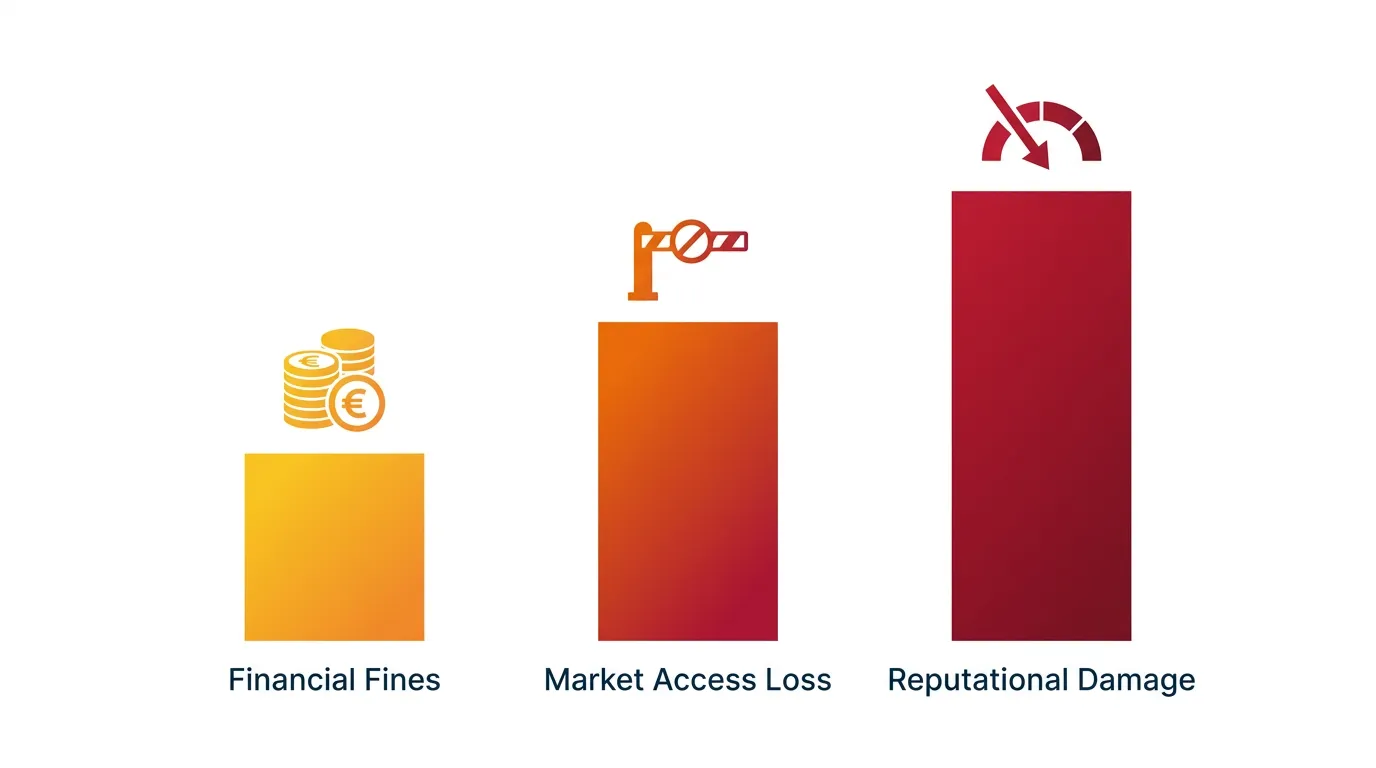
Regulatory Penalties and Fines
The ESPR grants EU authorities significant enforcement power, with penalties designed to genuinely deter non-compliance:
Direct fines: Member states can impose penalties up to 4% of annual turnover for serious violations. For a Shopify store with €5 million in European revenue, that's a potential €200,000 fine—far exceeding the cost of implementing a DPP system.
Product-specific penalties: Some product categories face per-item fines, particularly for restricted substances violations or mis-labeling. Electronics and textiles, the first categories subject to DPP requirements, can incur fines of €500-5,000 per non-compliant unit discovered in market surveillance.
Escalating enforcement: Early enforcement focuses on education and warnings, but regulatory authorities have signaled that post-2027, penalties will increase as grace periods expire. Early compliance means avoiding the strictest enforcement period.
Market Access Restrictions
Beyond fines, non-compliance creates operational barriers:
Customs holds and seizures: Products without proper DPP documentation can be stopped at EU borders. Even temporary holds create inventory disruptions, disappointed customers, and tied-up capital. Products deemed non-compliant may be seized and destroyed, representing total inventory loss.
Retailer delisting: Major European marketplaces and retail partners are building DPP compliance into vendor requirements. Zalando, About You, and other major platforms have announced product information standards that align with DPP frameworks. Non-compliant products risk delisting from these sales channels.
B2B customer requirements: If you sell to other businesses, expect procurement departments to require DPP compliance as part of vendor qualification. Corporate sustainability reporting requirements flow downstream, making your transparency their requirement.
Estimated Cost of Non-Compliance
For a mid-sized e-commerce brand with €2-10 million in EU revenue:
- Risk-adjusted penalty exposure: €50,000-250,000 (accounting for enforcement probability)
- Market access disruption: 15-30% revenue reduction if delisted from major platforms
- Product seizure risk: 2-5% of inventory value for non-compliant products
- Legal and remediation costs: €25,000-100,000 to respond to regulatory actions
Total downside risk: €150,000-€500,000 over a 2-3 year period.
Now, compare that to DPP implementation costs, which we'll detail below, typically ranging from €15,000-75,000 depending on catalog size and complexity.
The Positive ROI Drivers: How DPP Creates Business Value
Avoiding fines is just the baseline. The real business case for Digital Product Passports comes from tangible revenue and margin improvements.
Driver 1: Increased Conversion Rates Through Consumer Trust
Transparency sells. Multiple studies demonstrate that product transparency directly impacts purchasing decisions:
Consumer trust statistics:
- 73% of consumers say they would pay more for products with complete transparency (Label Insight, 2024)
- 86% of consumers want to know what products are made of before purchasing (IBM/NRF study)
- Transparent product information increases purchase confidence by 42% (Stackla research)
Conversion rate improvements: E-commerce brands implementing comprehensive product transparency see conversion rate increases of 8-15% on products with detailed sustainability information compared to similar products without transparency data.
Calculation example:
- Current monthly EU revenue: €100,000
- Average conversion rate: 2.5%
- Conversion rate improvement with DPP: +10%
- New conversion rate: 2.75%
- Monthly revenue increase: €10,000
- Annual revenue increase: €120,000
For products where sustainability is a key purchase driver (fashion, beauty, home goods), the impact is even more pronounced, with conversion improvements reaching 20-25%.
Driver 2: Premium Pricing Power for Transparent Brands
Transparency doesn't just drive volume—it supports higher price points.
Price premium statistics:
- Consumers report willingness to pay 9-12% premiums for sustainable products with verified transparency (Nielsen sustainability study)
- Brands with strong sustainability credentials achieve average price premiums of 25-30% in categories like organic food and sustainable fashion (McKinsey research)
- Younger consumers (Gen Z and Millennials), who increasingly dominate purchasing power, show 35% higher willingness to pay for transparent sustainable products
Real-world validation: Fashion brands like Patagonia, Veja, and Allbirds successfully command premium pricing partly due to radical supply chain transparency. While brand strength plays a role, transparency enables premium positioning.
Calculation example:
- Current average order value: €75
- Product catalog: 50% suitable for sustainability positioning
- Conservative price increase: 5% on sustainable line
- Orders affected monthly: 500
- Monthly revenue increase: €1,875
- Annual revenue increase: €22,500
Combined with conversion improvements, transparency-driven revenue gains compound significantly.
Driver 3: Reduced Return Rates Through Better Product Information
Return rates plague e-commerce profitability, with fashion and apparel seeing returns of 20-30%. Comprehensive product information demonstrably reduces returns.
How DPP reduces returns:
- Detailed material composition helps customers understand fabric feel, durability, and care requirements
- Sizing information tied to manufacturing specifications improves fit accuracy
- Transparent product imagery and descriptions set accurate expectations
- Durability and quality information reduces "not as expected" returns
Return rate reductions: Brands implementing detailed product content systems (which DPP requires) see return rate decreases of 15-25%.
Calculation example:
- Monthly EU revenue: €100,000
- Current return rate: 25%
- Returns cost (processing, shipping, depreciation): 60% of returned item value
- Returns cost monthly: €15,000
- Return rate reduction with DPP: 20%
- New monthly returns cost: €12,000
- Monthly savings: €3,000
- Annual savings: €36,000
The financial impact extends beyond direct costs—reduced returns mean less customer service time, fewer negative reviews from disappointed customers, and better inventory turnover.
Driver 4: Marketing Value and Competitive Differentiation
Sustainability transparency is marketing gold, particularly as greenwashing regulations tighten and consumers grow skeptical of unsubstantiated claims.
Marketing advantages of DPP:
Credible sustainability storytelling: DPP provides verified data that powers authentic marketing campaigns. Instead of vague claims like "eco-friendly," you can state "27% lower carbon footprint than industry average, verified through product lifecycle assessment."
Content marketing opportunities: Supply chain transparency generates compelling content—factory stories, material journey narratives, sustainability impact metrics—that drives organic traffic and social engagement.
PR and media coverage: Brands leading on transparency earn disproportionate media attention. Early DPP adopters position themselves as sustainability leaders, earning press coverage worth €50,000-500,000 in advertising value equivalency.
Influencer and partnership appeal: Sustainability influencers and brand partners increasingly require verified transparency before collaboration. DPP opens doors to partnerships that drive customer acquisition.
Social proof and trust signals: Displaying DPP badges and transparency information creates trust signals that reduce purchase friction, similar to security badges and customer reviews.
Value estimation: Quantifying marketing value is challenging, but consider:
- Organic traffic increase from sustainability content: 15-30% for content-focused brands
- Customer acquisition cost reduction through earned media: 10-20%
- Social engagement improvements: 25-50% on transparency-focused campaigns
Conservative estimate: €20,000-100,000 annual marketing value depending on brand size and content strategy sophistication.
Driver 5: Customer Loyalty and Lifetime Value Improvements
Transparency builds emotional connections that drive repeat purchases.
Loyalty statistics:
- 88% of consumers say sustainability transparency increases brand loyalty (Cone Communications)
- Customers who align with a brand's values have 306% higher lifetime value (Harvard Business Review)
- Transparent brands see 25-40% higher customer retention rates in sustainable product categories
Calculation example:
- Customer lifetime value (current): €250
- Customer retention improvement: 15%
- Annual new customers: 2,000
- Additional retained customers: 300
- Lifetime value of retained customers: €75,000
- Spread over 3-year average customer lifespan: €25,000 annual value
This doesn't account for increased purchase frequency, which transparent brands also experience as customers trust and identify with brand values.
Driver 6: Risk Mitigation and Greenwashing Protection
Regulatory scrutiny of sustainability claims is intensifying. The EU Green Claims Directive and similar regulations globally make unsubstantiated environmental claims legally risky and potentially expensive.
Greenwashing risks:
- Fines up to 2.5% of revenue for misleading environmental claims under proposed EU regulations
- Reputational damage from greenwashing investigations or exposés (nearly impossible to quantify but potentially business-threatening)
- Class action lawsuits in jurisdictions with consumer protection statutes
DPP as protection: A properly implemented Digital Product Passport provides documentary evidence supporting sustainability claims, dramatically reducing greenwashing risk. The data trail created through DPP implementation serves as legal protection.
Value: Risk mitigation has real financial value. Insurance frameworks typically value risk mitigation at 3-5x the annual probability-adjusted loss. If greenwashing risk carries a 10% annual probability of €100,000 in fines/costs, mitigation is worth €30,000-50,000 annually.
Driver 7: B2B and Wholesale Opportunities
Corporate procurement increasingly requires supplier sustainability transparency for Scope 3 emissions reporting and ESG compliance.
If you sell to other businesses or retailers:
- Sustainability reporting capabilities become vendor qualification requirements
- DPP positions you to serve corporate customers with strong ESG mandates
- Premium corporate accounts often require transparency documentation
B2B value: Access to corporate accounts worth 20-40% revenue growth for brands successfully pivoting to B2B channels enabled by DPP capabilities.
Driver 8: Early Mover Competitive Advantage
In emerging regulatory environments, first movers capture disproportionate advantages:
Market positioning: Early DPP adopters are recognized as category leaders, earning media coverage, investor interest, and customer loyalty before competitors react.
Operational learning curve: Implementing DPP takes 6-12 months including supplier data collection and system integration. Starting early means you're optimized when competitors are scrambling to meet deadlines.
Supplier relationship leverage: Early engagement on transparency positions you as a strategic partner to manufacturers, potentially securing better pricing, priority allocation, and collaborative innovation.
Customer acquisition during competitor disruption: When competitors face compliance scrambles, product delisting, or market access issues, your seamless operations capture displaced customers.
Value quantification: First-mover advantages are difficult to quantify precisely but market studies suggest early regulatory adapters achieve 15-25% market share gains in affected categories during 12-24 month windows when competitors struggle with compliance.
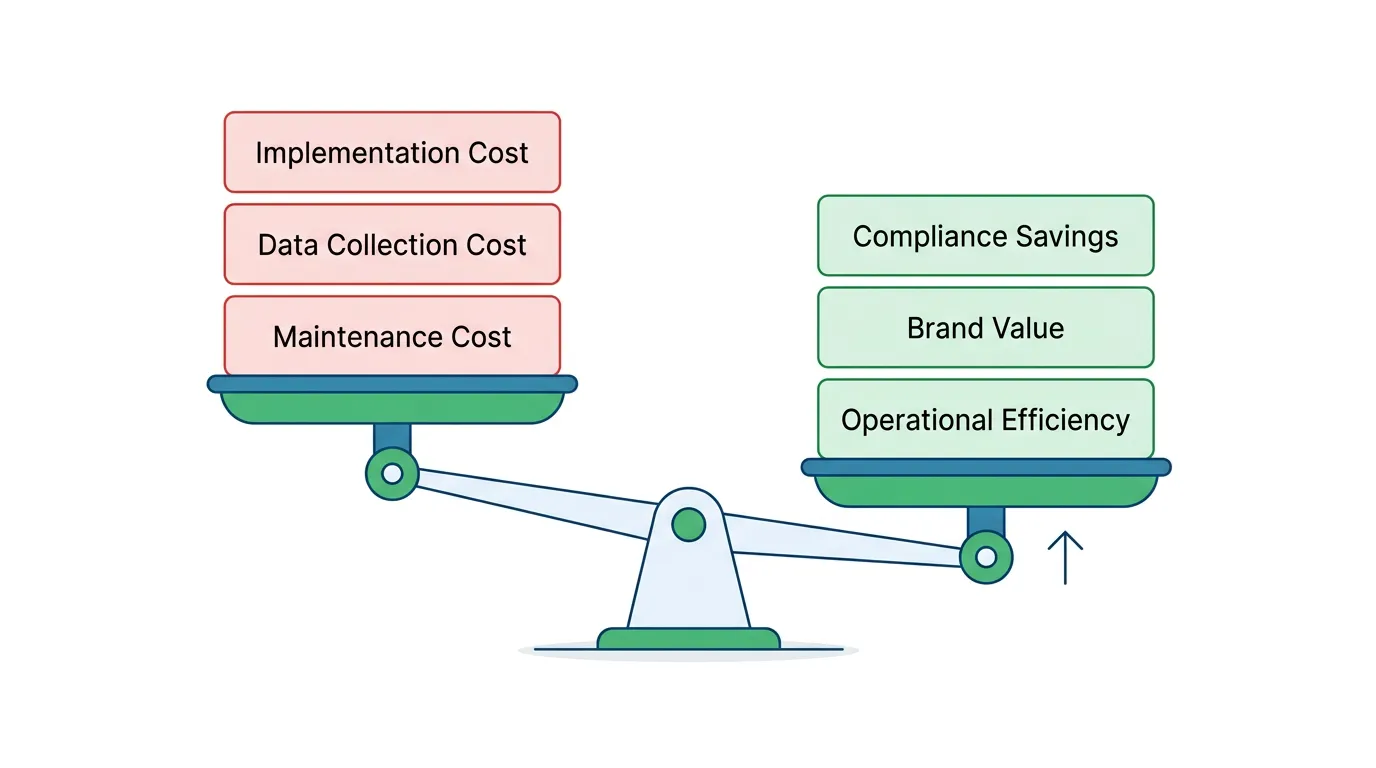
The Complete ROI Framework: Costs vs. Benefits
Now let's build a comprehensive ROI calculation framework you can adapt to your specific situation.
Implementation Costs
Software platform: €3,000-15,000 annually depending on catalog size, number of SKUs, and integration requirements. Solutions like PassportPro offer Shopify-native implementations that reduce integration costs compared to enterprise sustainability platforms.
Data collection and supplier management: €5,000-30,000 one-time cost for initial supplier outreach, data collection, and verification. This includes:
- Staff time for supplier communication (40-120 hours)
- Third-party testing or certification costs (€2,000-10,000)
- Consultant support if needed (€5,000-15,000)
Internal process development: €2,000-8,000 for developing workflows, training staff, and creating documentation protocols.
Content creation: €3,000-12,000 for developing transparency communications, updating product pages, and creating supporting content.
Ongoing maintenance: €2,000-6,000 annually for data updates, certificate renewals, and system maintenance.
Total first-year cost: €15,000-80,000 depending on catalog complexity and internal vs. outsourced execution.
Years 2-3 costs: €5,000-20,000 annually for ongoing software, data updates, and content maintenance.
Revenue and Margin Benefits (Annual)
Conversion rate improvement: €30,000-150,000 (10-15% improvement on €100,000-250,000 monthly revenue)
Premium pricing: €15,000-75,000 (5% price increase on 50% of product line)
Return rate reduction: €25,000-50,000 (20% fewer returns)
Customer lifetime value increase: €20,000-60,000 (improved retention and purchase frequency)
Marketing value: €15,000-50,000 (content, PR, organic traffic)
Total annual benefit: €105,000-385,000
Simple ROI Calculation
Conservative scenario (small catalog, modest improvements):
- First-year cost: €20,000
- First-year benefit: €105,000
- Year 1 ROI: 425%
- Payback period: 2.3 months
Mid-range scenario (medium catalog, typical improvements):
- First-year cost: €45,000
- First-year benefit: €245,000
- Year 1 ROI: 444%
- Payback period: 2.2 months
Complex scenario (large catalog, aggressive implementation):
- First-year cost: €75,000
- First-year benefit: €385,000
- Year 1 ROI: 413%
- Payback period: 2.3 months
Even in the most conservative scenarios, DPP implementation delivers returns that few business initiatives can match.
Three-Year Cumulative Value
The ROI compounds in years 2-3 as implementation costs drop but benefits continue growing:
Mid-range scenario 3-year projection:
- Year 1: -€45,000 cost + €245,000 benefit = €200,000 net
- Year 2: -€12,000 cost + €270,000 benefit (10% growth) = €258,000 net
- Year 3: -€12,000 cost + €295,000 benefit (10% growth) = €283,000 net
- 3-year cumulative value: €741,000
This projection assumes modest 10% year-over-year benefit growth, driven by expanding use of transparency data in marketing, growing consumer preference for transparent brands, and improving operational efficiency as processes mature.
Industry-Specific ROI Considerations
Fashion and Apparel
Highest DPP ROI potential due to:
- Strong consumer interest in sustainable fashion
- High return rates that transparency reduces
- Premium pricing opportunities in conscious fashion segment
- Regulatory priority (textiles are tier-1 DPP category)
Expected ROI: 450-600% first year
Beauty and Cosmetics
Strong ROI drivers:
- Ingredient transparency is primary purchase driver
- Regulatory scrutiny on safety and environmental claims
- Loyal, values-driven customer base willing to pay premiums
Expected ROI: 400-550% first year
Home Goods and Furniture
Moderate but growing ROI:
- Longer purchase cycles reduce annual revenue impact
- Growing consumer awareness around sustainable materials
- B2B opportunities with corporate buyers
Expected ROI: 300-450% first year
Electronics and Accessories
Emerging ROI opportunity:
- ESPR prioritizes electronics for early DPP implementation
- Right-to-repair movements increase consumer interest in product information
- Material transparency addresses e-waste concerns
Expected ROI: 350-500% first year, growing as regulations take effect
Making the Business Case to Stakeholders
When presenting DPP ROI to executives, investors, or board members, structure your argument around three pillars:
1. Risk Mitigation (Defensive Case)
The ask: "We need to invest €X to avoid regulatory penalties and market access risks that could cost us €Y (where Y is 5-10x larger than X)."
Key points:
- Quantify non-compliance costs specific to your business
- Show regulatory timeline and enforcement expectations
- Highlight competitor moves to avoid being caught behind market
2. Revenue Growth (Offensive Case)
The ask: "This investment will drive €X in incremental revenue through improved conversion, pricing power, and customer loyalty."
Key points:
- Use conservative conversion and pricing improvement estimates
- Show consumer research demonstrating transparency preferences
- Reference case studies from similar brands (if available)
3. Strategic Positioning (Long-term Value)
The ask: "Early implementation positions us as a category leader in sustainability, creates competitive moats, and builds brand equity that compounds over years."
Key points:
- Frame as multi-year strategic initiative, not annual expense
- Connect to broader brand values and positioning
- Highlight first-mover advantages and competitive intelligence gained
Common ROI Objections and Responses
"Our customers don't care about sustainability"
Response: While sustainability may not be the primary purchase driver, transparency builds trust across all customer segments. Product information accuracy reduces returns regardless of environmental motivations. Plus, regulatory compliance isn't optional even if customers don't demand it.
"We're too small to justify this investment"
Response: Smaller catalogs mean lower implementation costs. A 50-SKU Shopify store can implement DPP for €10,000-20,000, likely seeing payback in 2-3 months through conversion improvements alone. Additionally, small brands often compete on values and quality rather than price, making transparency a key differentiator.
"We'll wait and see what competitors do"
Response: Waiting means missing first-mover advantages and potentially scrambling to meet regulatory deadlines. Supplier data collection takes 3-6 months even with cooperative partners. Starting now means optimized operations when enforcement begins, while delayed action means implementation during peak pressure.
"ROI is too speculative"
Response: Start with a pilot. Implement DPP on your top 20% of SKUs (by revenue), measure conversion rate impact over 3 months, and calculate actual ROI before full rollout. Most platforms like PassportPro offer scalable pricing that supports phased implementation.
Implementation Strategy for Maximum ROI
To ensure your DPP initiative delivers projected returns:
Start with high-impact products: Prioritize SKUs with highest margins, strongest sustainability stories, or most engaged customer bases. These will show ROI fastest, creating momentum for broader rollout.
Integrate with existing marketing: Don't treat DPP as a compliance project—leverage transparency data across all customer touchpoints (product pages, email campaigns, social media, packaging) to maximize marketing value.
Measure and optimize: Track conversion rates, return rates, and customer feedback on products with DPP vs. without. Use data to refine messaging and identify which transparency elements drive most value.
Build supplier relationships: Frame data collection as partnership development. Suppliers who engage meaningfully often surface innovation opportunities, cost savings, or quality improvements beyond compliance data.
Choose scalable technology: Platform selection significantly impacts ROI. Shopify-integrated solutions like PassportPro reduce implementation time and technical costs compared to standalone systems requiring custom integration.
The Bottom Line: DPP as Growth Investment, Not Compliance Cost
Digital Product Passports represent a rare alignment of regulatory requirement, consumer demand, and business opportunity. The companies that recognize DPP as a growth driver rather than a compliance burden will capture market share, build brand equity, and achieve margins that competitors can't match.
The math is compelling: first-year ROI of 400-600% for most e-commerce brands, with compounding benefits in subsequent years. Implementation costs are modest—roughly equivalent to a mid-level marketing campaign—but returns persist and grow over time.
The question isn't whether to implement DPP, but how quickly you can move to capture early-mover advantages before the market catches up.
Start by mapping your highest-potential SKUs, estimate your specific ROI using the framework above, and explore implementation partners who can accelerate time-to-value. The regulatory deadline is fixed, but the business opportunity favors those who act decisively.
Your next step: calculate your specific ROI, identify your implementation path, and commit to transparency as a competitive advantage rather than a regulatory cost. The brands that lead on transparency today will define their categories tomorrow.
Ready to get started?
Create EU-compliant Digital Product Passports for your Shopify store in minutes.
Install PassportPro on Shopify